
Hyundai Ioniq (AE): Fuel Delivery System / Components and components location
| Components Location |
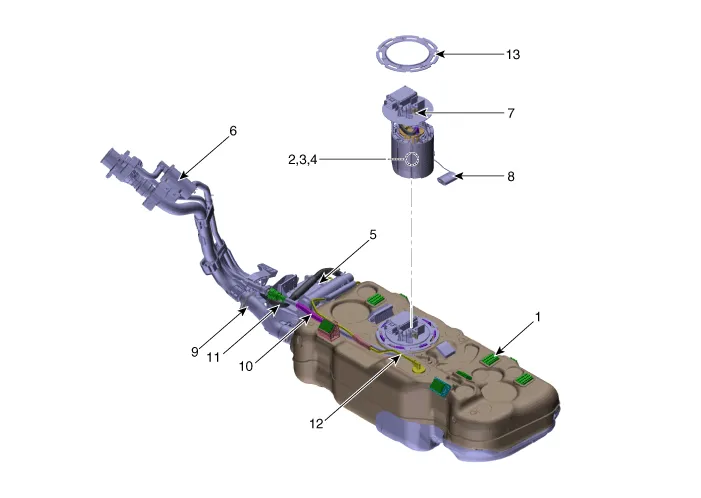
| 1. Fuel tank 2. Fuel pump 3. Fuel filter 4. Fuel pressure regulator 5. Canister 6. Fuel tank air Filter 7. Fuel pressure sensor (FPS) | 8. Fuel level sensor (FLS) 9. Fuel Filler hose 10. Leveling hose 11. Vent hose 12. Vapor tube 13. Fuel pump plate cover |
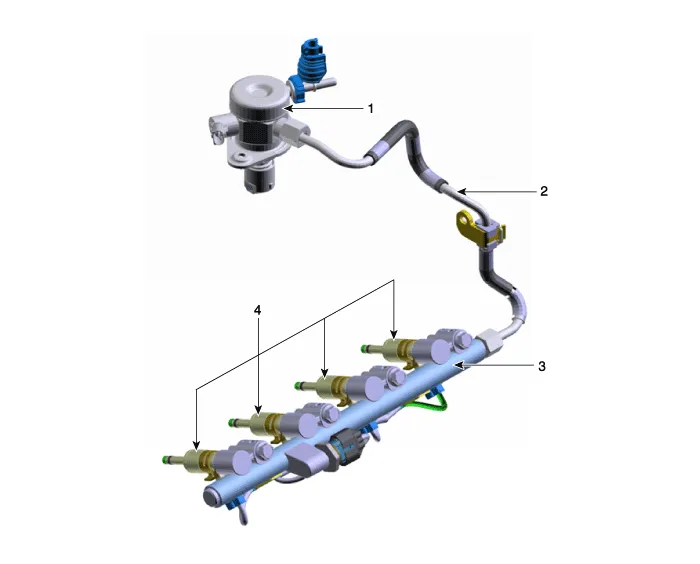
| 1. High pressure fuel pump 2. High pressure fuel pipe | 3. Delivery pipe 4. Injector |
|

Fuel Pressure Test1.Release the residual pressure in fuel line.(Refer to Fuel Delivery System - "Release Residual Pressure in Fuel Line") • When removing the fuel pump fuse, a Diagnostic Trouble Code (DTC) may occur.
Other information:
Hyundai Ioniq (AE) 2017-2022 Service & Repair Manual: Schematic diagrams
Trouble Symptom ChartsComponent Parts and Function Outline Component part Function Cruise Control Switch Input the set speed and distance to the SCC ECU. Instrument Cluster Display various information inputted from SCC.
Hyundai Ioniq (AE) 2017-2022 Service & Repair Manual: Troubleshooting
Trouble Symptom ChartsTrouble Symptom 1Trouble Symptom 2 Trouble symptom Probable cause Remedy The set vehicle speed varies greatly upward or downward"Surging" (repeated alternating acceleration and deceleration) occurs after settingMalfunction of the vehicle speed se
Categories
- Manuals Home
- Hyundai Ioniq Owners Manual
- Hyundai Ioniq Service Manual
- Repair procedures
- DCT(Dual Clutch Transmission) System
- Transmission Gear Oil. Repair procedures
- New on site
- Most important about car
