
Hyundai Ioniq (AE): ETC (Electronic Throttle Control) System / Description and operation
Hyundai Ioniq (AE) 2017-2022 Service & Repair Manual / Engine Control/Fuel System / Engine Control System / ETC (Electronic Throttle Control) System / Description and operation
| Description |
The Electronic Throttle Control (ETC) System consists of a throttle body with an integrated control motor and throttle position sensor (TPS). Instead of the traditional throttle cable, an Accelerator Position Sensor (APS) is used to receive driver input. The ECM uses the APS signal to calculate the target throttle angle; the position of the throttle is then adjusted via ECM control of the ETC motor. The TPS signal is used to provide feedback regarding throttle position to the ECM. Using ETC, precise control over throttle position is possible; the need for external cruise control modules/cables is eliminated.
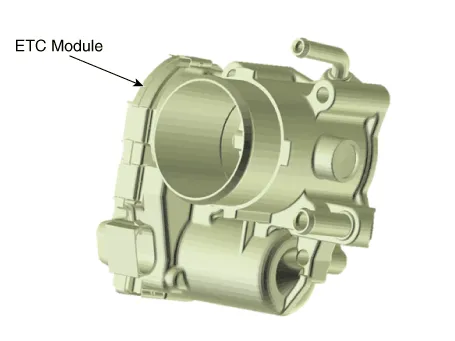
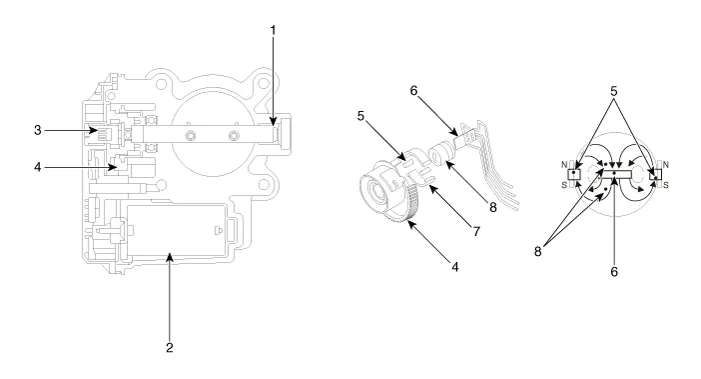
| 1. Dry bearing 2. DC motor 3. Non-contact hall sensor 4. Gear | 5. Magnet 6. Hall IC 7. Yoke 8. Stator |
Specification[Throttle Position Sensor (TPS)] Throttle angle (°) Output Voltage (V) [Vref=5V] TPS1 TPS2 00.
Categories
- Manuals Home
- Hyundai Ioniq Owners Manual
- Hyundai Ioniq Service Manual
- Troubleshooting
- Body (Interior and Exterior)
- Description and operation
- New on site
- Most important about car

Copyright © 2026 www.hioniqae.com - 0.0147