
Hyundai Ioniq (AE): Fuel Delivery System / Release residual pressure in fuel line
| Release Residual Pressure in Fuel Line |
|

|

| 1. | Turn the ignition off and disconnect the battery negative cable. |
| 2. | Remove the fuel pump fuse (A).
|
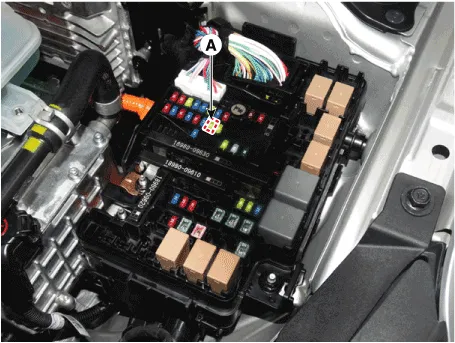
| 3. | Disconnect the electrical connector from the high pressure fuel pump. |
| 4. | Reconnect the battery negative cable. |
| 5. | Run the engine for about 20 seconds to lower the pressure in both the high or low pressurelines. The engine may shut off within the 20 second period. If not, turn the engine off. |
| 6. | Proceed with the service or repair. Use rags to cover opening and catch spills when opening up the high pressure system. |
| 7. | Reinstall / re-connect all components in reverse order of removal. Start engine and confirm proper operation, and make sure there are no fuel leaks. |
| 8. | After completing, clear DTC(s) using GDS scan tool (the procedure described above will cause DTC to set). |
Fuel Pressure Test1.Release the residual pressure in fuel line.(Refer to Fuel Delivery System - "Release Residual Pressure in Fuel Line") • When removing the fuel pump fuse, a Diagnostic Trouble Code (DTC) may occur.
Removal1.Turn the ignition switch OFF and disconnect the battery negative (-) cable.2.Remove the rear seat cushion. (Refer to Body - "Rear Seat Assembly")3.
Other information:
Hyundai Ioniq (AE) 2017-2022 Service & Repair Manual: Photo Sensor. Description and operation
Description The photo sensor is located at the center of the defrost nozzles.The photo sensor contains a photovoltaic (sensitive to sunlight) diode. The solar radiation received by its light receiving portion, generates an electromotive force in proportion to the amount of radiation received which is transferred to the automatic temperature control
Hyundai Ioniq (AE) 2017-2022 Service & Repair Manual: Heater Unit. Repair procedures
Replacement When prying with a flat-tip screwdriver or use a prying trim tool, wrap it with protective tape, and apply protective tape around the related parts, to prevent damage.1.Disconnect the negative (-) battery terminal.2.Recover the refrigerant with a recovery / recycling / charging station.
Categories
- Manuals Home
- Hyundai Ioniq Owners Manual
- Hyundai Ioniq Service Manual
- Brake System
- Maintenance
- DCT(Dual Clutch Transmission) System
- New on site
- Most important about car
