
Hyundai Ioniq (AE): Seat Electrical / Air Ventilation Seat. Components and components location
| Component Location |
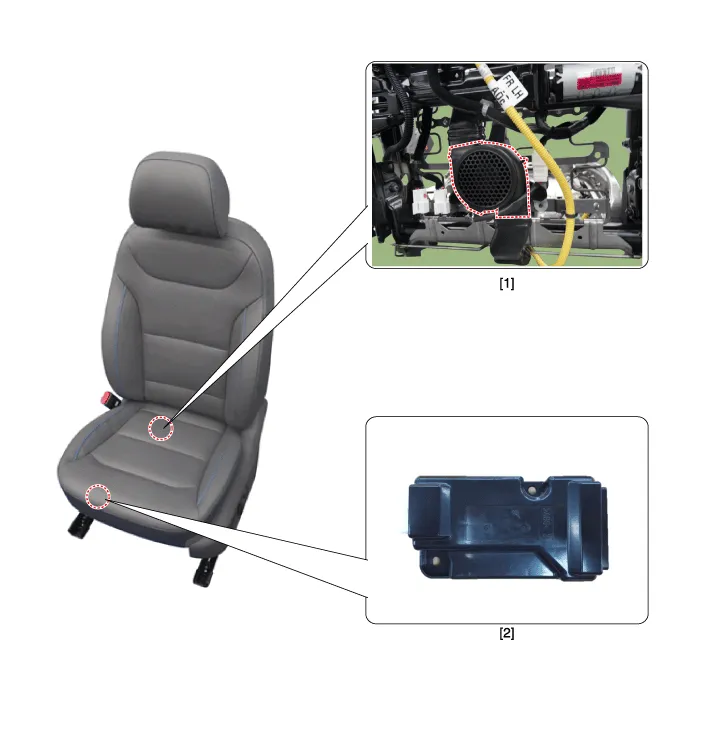
| 1. Ventilation seat unit (Assist seat only) | 2. Ventilation seat blower |
Removal[Front Seat]1.Disconnect the negative (-) battery terminal.2.Remove the floor console upper cover.(Refer to Body - "Floor Console Assembly")3.Remove the seat heater switch after loosening mounting screws.
Circuit Diagram NO Connector A Connector B Connector C 1Ventilation seat unit (IGN1)Driver ventilation LED (Low)Ventilation heater power2Driver bolwer powerDriver ventilation LED (mid)Driver heater power3Driver bolwer SpeedDriver ventilation LED (High)-4Driver RPM inputDriver NTC (+)Heater ground5heater switch (Driver)-Ventilation heater power6Ventilation switch (Driver)--7-Driver NTC (-)Passenger heater power8Driver heater led (Low)Driver blower ground-9Driver heater led (mid)Driver ventilation LED (Low)-10Driver heater led (High)Driver ventilation LED (mid)Heater ground11Ventilation seat unit (IGN 2)Driver ventilation LED (High)12Passenger blower powerPassenger NTC (+)13Passenger blower speed-14Passenger blower RPM input-15Passenger heater switchPassenger NTC (-)16Passenger ventilation switchPassenger blower ground17-18Passenger ventilation LED (Low)19Passenger ventilation LED (mid)20Passenger ventilation LED (High)
Other information:
Hyundai Ioniq (AE) 2017-2022 Service & Repair Manual: Duct Sensor. Repair procedures
Inspection1.Check that the voltage values of No. 1, 2 duct sensors change1. Sensor (+ 5V)2. Sensor groundSpecification Ambient temperature [°C (°F)] Resistance (kΩ) Voltage (V) 50 (122)1.
Hyundai Ioniq (AE) 2017-2022 Service & Repair Manual: Description and operation
Cruise ControlThe cruise control system is engaged by the cruise "ON/OFF" main switch located on right of steering wheel column. The system has the capability to cruise, coast, accelerate and resume speed.It also has a safety interrupt, engaged upon depressing brake or shifting select lever.
Categories
- Manuals Home
- Hyundai Ioniq Owners Manual
- Hyundai Ioniq Service Manual
- Jump starting procedure
- General Information
- Suspension System
- New on site
- Most important about car
