
Hyundai Ioniq (AE): Fuel Delivery System / Fuel Pump Control Module (FPCM). Schematic diagrams
| Circuit Diagram |
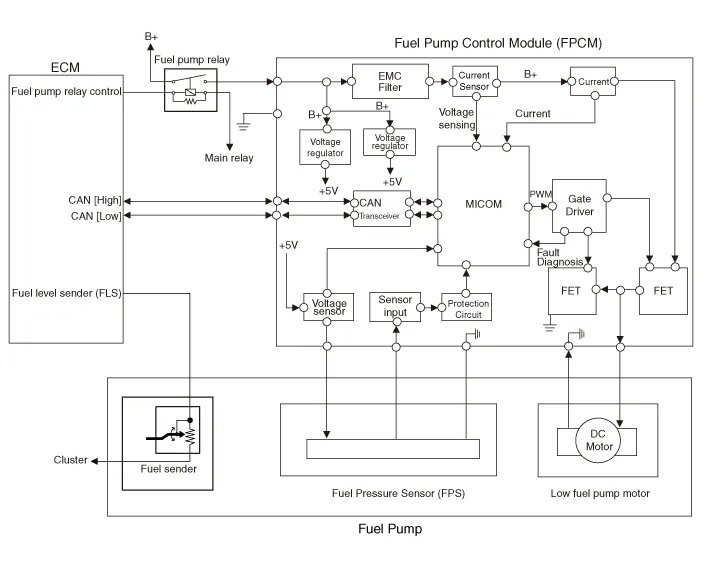
| Fuel Pressure Control Module (FPCM) Terminal And Input/Output signal |

| FPCM Terminal Function |
|
Pin No
|
Discription
|
Connected to
|
| 1 | Fuel sender ground | Fuel Pump |
| 2 | Fuel pressure sensor (FPS) signal input | Fuel Pressure Sensor (FPS) |
| 3 | Fuel pressure sensor (FPS) ground (-) | Fuel Pressure Sensor (FPS) |
| 4 | Ground | Chassis Ground |
| 5 | CAN [Low] | ECM |
| 6 | Fuel sender signal | Fuel Pump |
| 7 | - | - |
| 8 | Fuel pressure sensor (FPS) Power supply (+5V) | Fuel Pressure Sensor (FPS) |
| 9 | CAN [High] | ECM |
| 10 | Battery power (B+) | Fuel Pump Relay |
DescriptionThe fuel pump control module (FPCM) is installed on the right side of the fuel tank and controls the DC motor mounted inside the low pressure fuel pump.
Removal1.Turn the ignition switch OFF and disconnect the battery negative (-) cable.2.Remove the rear seat cushion. (Refer to Body - "Rear Seat Assembly")3.
Other information:
Hyundai Ioniq (AE) 2017-2022 Service & Repair Manual: Special service tools
Special Service Tools Tool Name / Number Illustration Description LKA Compensator(09964-C1100)Used for compensating front view camera unitBCW Sensor Correction Tool Set(09958-3T500)Used to correct the blind-spot radar unit.
Hyundai Ioniq (AE) 2017-2022 Service & Repair Manual: Schematic diagrams
Trouble Symptom ChartsComponent Parts and Function Outline Component part Function Cruise Control Switch Input the set speed and distance to the SCC ECU. Instrument Cluster Display various information inputted from SCC.
Categories
- Manuals Home
- Hyundai Ioniq Owners Manual
- Hyundai Ioniq Service Manual
- General Information
- If the 12 Volt Battery is Discharged (Hybrid Vehicle)
- Repair procedures
- New on site
- Most important about car
