
Hyundai Ioniq (AE): Rear Seat Belt / Rear Seat Belt Buckle. Repair procedures
Hyundai Ioniq (AE) 2017-2022 Service & Repair Manual / Body (Interior and Exterior) / Rear Seat Belt / Rear Seat Belt Buckle. Repair procedures
| Replacement |
| 1. | Remove the rear seat cushion assembly. (Refer to Rear Seat - "Rear Seat Cushion Assembly") |
| 2. | Loosen the mounting bolt, remove the rear seat belt buckle (A). [LH]
[RH]
|
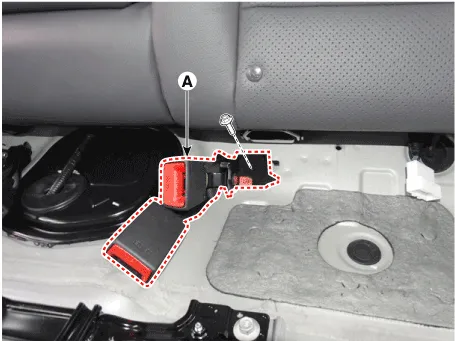
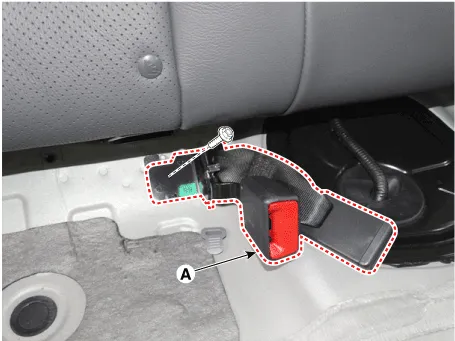
| 3. | To install, reverse the removal procedure.
|

Component Location 1. Rear seat belt buckle [RH]2. Rear seat belt buckle [LH]3. Rear center seat belt buckle
Other information:
Hyundai Ioniq (AE) 2017-2022 Service & Repair Manual: Heater Unit. Repair procedures
Replacement When prying with a flat-tip screwdriver or use a prying trim tool, wrap it with protective tape, and apply protective tape around the related parts, to prevent damage.1.Disconnect the negative (-) battery terminal.2.Recover the refrigerant with a recovery / recycling / charging station.
Hyundai Ioniq (AE) 2017-2022 Service & Repair Manual: Schematic diagrams
Trouble Symptom ChartsComponent Parts and Function Outline Component part Function Cruise Control Switch Input the set speed and distance to the SCC ECU. Instrument Cluster Display various information inputted from SCC.
Categories
- Manuals Home
- Hyundai Ioniq Owners Manual
- Hyundai Ioniq Service Manual
- Front Disc Brake. Repair procedures
- Jump Starting
- Engine Control/Fuel System
- New on site
- Most important about car

Copyright © 2026 www.hioniqae.com - 0.0136