
Hyundai Ioniq (AE): Fuel Delivery System / Components and components location
Hyundai Ioniq (AE) 2017-2022 Service & Repair Manual / Engine Control/Fuel System / Fuel Delivery System / Components and components location
| Components Location |
[Fuel Tank]
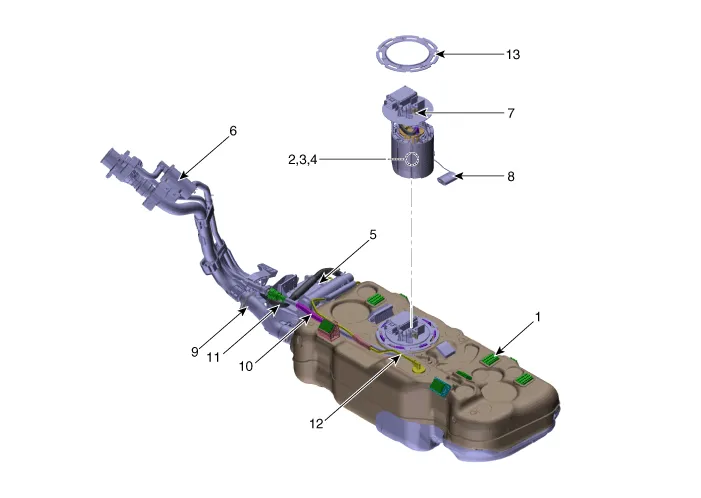
| 1. Fuel tank 2. Fuel pump 3. Fuel filter 4. Fuel pressure regulator 5. Canister 6. Fuel tank air Filter 7. Fuel pressure sensor (FPS) | 8. Fuel level sensor (FLS) 9. Fuel Filler hose 10. Leveling hose 11. Vent hose 12. Vapor tube 13. Fuel pump plate cover |
[High Pressure Fuel Line]
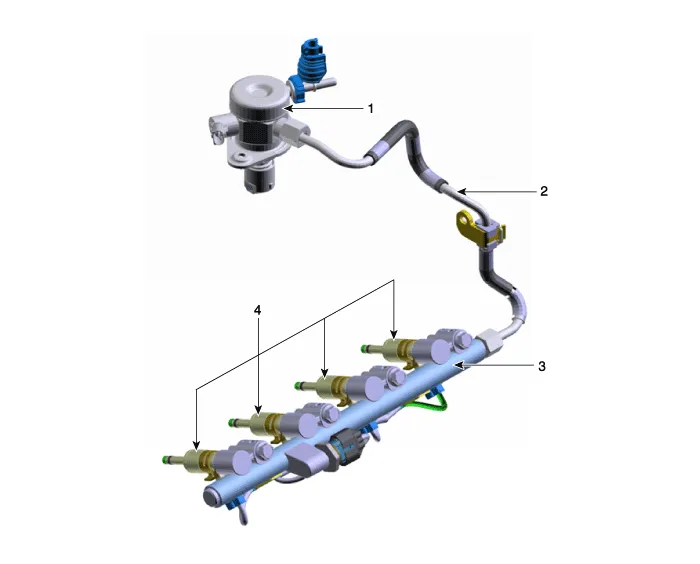
| 1. High pressure fuel pump 2. High pressure fuel pipe | 3. Delivery pipe 4. Injector |
|

Fuel Pressure Test1.Release the residual pressure in fuel line.(Refer to Fuel Delivery System - "Release Residual Pressure in Fuel Line") • When removing the fuel pump fuse, a Diagnostic Trouble Code (DTC) may occur.
Other information:
Hyundai Ioniq (AE) 2017-2022 Service & Repair Manual: Auto Defoging Actuator. Components and components location
C
Hyundai Ioniq (AE) 2017-2022 Service & Repair Manual: Description and operation
DescriptionRear view monitor (RVM) will activate when the backup light is ON with the ignition switch ON and the shift lever in the R position.This system is a supplemental system that shows behind the vehicle through the AV monitor while backing-up. • This system is a supplementary function only.
Categories
- Manuals Home
- Hyundai Ioniq Owners Manual
- Hyundai Ioniq Service Manual
- Hybrid Control System
- General Information
- Front Disc Brake. Repair procedures
- New on site
- Most important about car

Copyright © 2026 www.hioniqae.com - 0.014