
Hyundai Ioniq (AE): Fuel Delivery System / Fuel pressure test
| Fuel Pressure Test |
| 1. | Release the residual pressure in fuel line. (Refer to Fuel Delivery System - "Release Residual Pressure in Fuel Line")
|

| 2. | Install the Special Service Tool (SST).
|
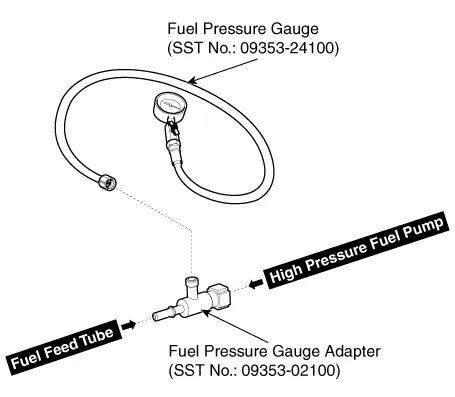
| 3. | Inspect fuel leakage on connections among the fuel feed tube, the high pressure fuel pump, and the SST components with IG ON. |
| 4. | Measure Fuel Pressure.
|

| 5. | Release the residual pressure in fuel line. (Refer to Fuel Delivery System - "Release Residual Pressure in Fuel Line")
|
| 6. | Test End
|
Components Location[Fuel Tank]1. Fuel tank2. Fuel pump3. Fuel filter4. Fuel pressure regulator5. Canister6. Fuel tank air Filter7. Fuel pressure sensor (FPS)8.
Release Residual Pressure in Fuel Line • Whenever the high pressure fuel pump, fuel pipe, delivery pipe, or injector is removed immediately after shutting off the engine, an injury may be caused by the release of highly pressurized fuel.
Other information:
Hyundai Ioniq (AE) 2017-2022 Service & Repair Manual: Description and operation
System OverviewParking Distance Warning (PDW) is an electronic driving aid that warns the driver to be cautious while parking or driving at low speed. The sensor uses ultrasonic waves to detect objects within proximity of the vehicle.PDW consists of four RPS sensors which are detecting the obstacles and transmit the result separated into three war
Hyundai Ioniq (AE) 2017-2022 Service & Repair Manual: Description and operation
DescriptionRear view monitor (RVM) will activate when the backup light is ON with the ignition switch ON and the shift lever in the R position.This system is a supplemental system that shows behind the vehicle through the AV monitor while backing-up. • This system is a supplementary function only.
Categories
- Manuals Home
- Hyundai Ioniq Owners Manual
- Hyundai Ioniq Service Manual
- Hybrid Vehicle Engine Compartment
- Brake System
- Engine Clutch System
- New on site
- Most important about car
