
Hyundai Ioniq (AE): Fuel Delivery System / Fuel Pressure Sensor (FPS). Repair procedures
| Removal |
| 1. | Turn the ignition switch OFF and disconnect the battery negative (-) cable. |
| 2. | Remove the rear seat cushion. (Refer to Body - "Rear Seat Assembly") |
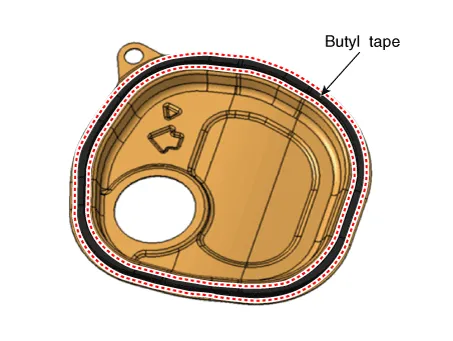
| 3. | Remove the fuel pump service cover (A).
|


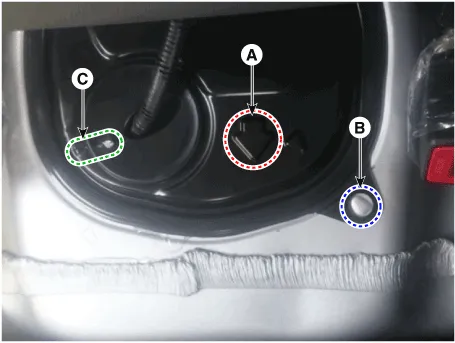
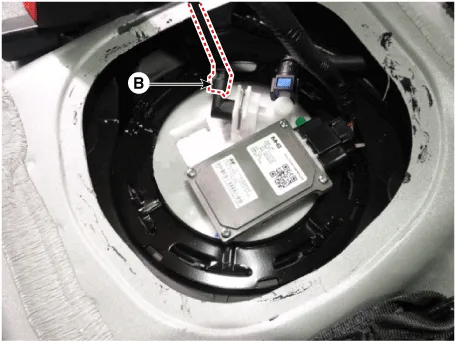
| 4. | Disconnect the fuel pressure sensor connector (B).
|
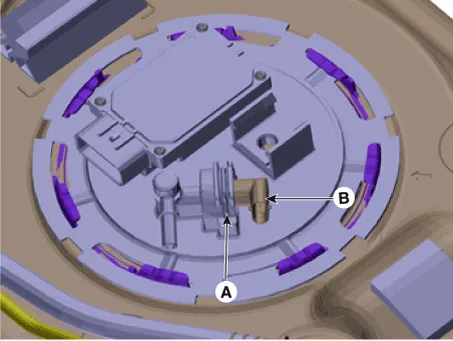
| 5. | Remove the fuel pressure sensor fixing pin (A). |
| 6. | Remov ethe fuel pressure sensor (B) from the fuel pump.
|
| Installation |
| 1. | Install in the reverse order of removal. |
Circuit DiagramCircuit DiagramTerminal IllustrationTerminal Function Pin No Discription Connected to 1Fuel pressure sensor (FPS) Power supply (+5V)Fuel Pressure Sensor (FPS)2Fuel pressure sensor (FPS) signal inputFuel Pressure Sensor (FPS)3Fuel pressure sensor (FPS) ground (-)Fuel Pressure Sensor (FPS)
Removal • In case of removing the high pressure fuel pump, high pressure fuel pipe, delivery pipe, and injector, there may be injury caused by leakage of the high pressure fuel.
Other information:
Hyundai Ioniq (AE) 2017-2022 Service & Repair Manual: Blower Unit. Repair procedures
Replacement When prying with a flat-tip screwdriver or use a prying trim tool, wrap it with protective tape, and apply protective tape around the related parts, to prevent damage.1.Disconnect the negative (-) battery terminal.2.Recover the refrigerant with a recovery / recycling / charging station.
Hyundai Ioniq (AE) 2017-2022 Service & Repair Manual: Front View Camera Unit. Repair procedures
Removal1.Disconnect the negative (-) battery terminal.2.Remove the front view camera cover (A).3.Disconnect the front view camera connector (A).4.Remove the front view camera after disengaging the mounting bracket (A).Installation1.Align front view camera with windshield bracket using forward edge point (A).
Categories
- Manuals Home
- Hyundai Ioniq Owners Manual
- Hyundai Ioniq Service Manual
- Repair procedures
- Transmission Gear Oil. Repair procedures
- Jump starting procedure
- New on site
- Most important about car
