
Hyundai Ioniq (AE): Autonomous Emergency Braking(AEB) System / Components and components location
| Components |
| – | Detection device (radar and camera) that can recognize potential obstacles in the front. |
| – | Human-Machine Interface (HMI) to warn driver or change settings. |
| – | Braking system to automatically brake the car |
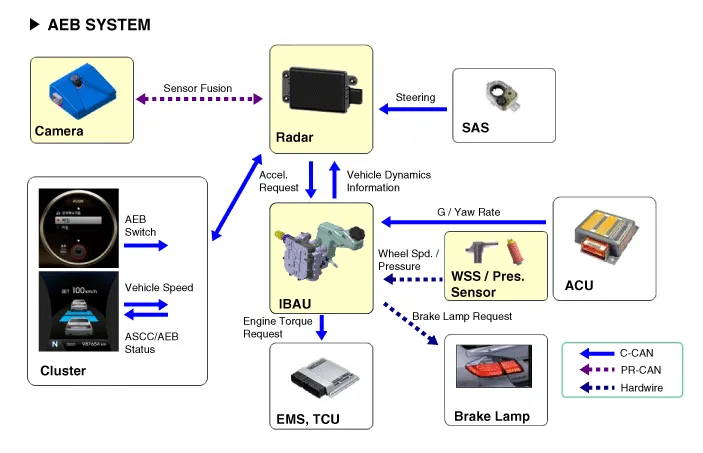
Description– AEB system is designed to help avoid a potential collision or reduce its impact when drivers applies inadequate, delayed or no brakes at all to avoid a collision.
Schematic DiagramTerminal Function No Terminal function 1B+2NC3NC4GND5NC6NC7C-CAN_Low8C-CAN_High9L-CAN_Low10IGN111NC12NC13NC14NC15NC16NC17NC18L-CAN_High
Other information:
Hyundai Ioniq (AE) 2017-2022 Service & Repair Manual: Description and operation
DescriptionIn ordinary cars, the mechanical water pump mounted on the engine for heating purposes is activated to circulate the cooling water, but in hybrid cars, AEWP is used to circulate the cooling water when the engine is not operating. Classification System Cooling water used
Hyundai Ioniq (AE) 2017-2022 Service & Repair Manual: Warning Indicator. Components and components location
C
Categories
- Manuals Home
- Hyundai Ioniq Owners Manual
- Hyundai Ioniq Service Manual
- DCT(Dual Clutch Transmission) System
- Hybrid Vehicle Engine Compartment
- Front Disc Brake. Repair procedures
- New on site
- Most important about car
