
Hyundai Ioniq (AE): Exhaust Emission Control System / GPF (Gasoline Particulate Filter). Repair procedures
Hyundai Ioniq (AE) 2017-2022 Service & Repair Manual / Engine Electrical System / Exhaust Emission Control System / GPF (Gasoline Particulate Filter). Repair procedures
| GPF Regeneration |
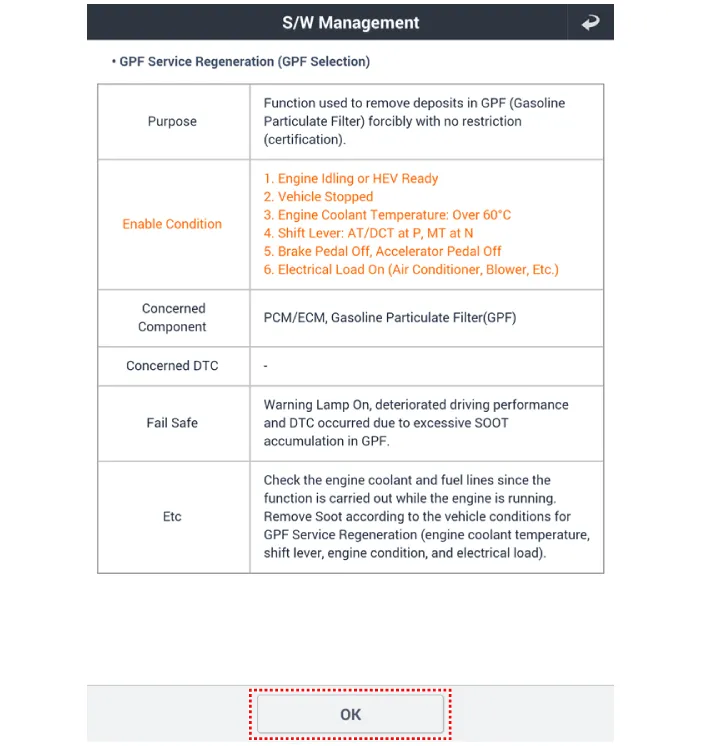
This procedures is to forcibly regenerate the GPF with scan tool when the GPF doesn't have been regenerated during driving. For example, if the vehicle has repeated "Low speed driving" or "Short distance driving", the GPF regeneration procedure cannot be proceeded because "Regeneration Mode" doesn't made.
|

Forcibly Regeneration Condition
| – | Engine coolant temperature : about 70°C |
| – | Engine at idle |
| – | P-range (A/T) or Neutral (M/T) |
| – | Normal battery voltage |
| – | Electrical fully load ON (A/C ON if equipped, Blower ON with maximum speed, Head Lamp ON, Wiper ON, Other Lamps ON, etc.). |
| 1. | Turn ignition switch OFF. |
| 2. | Connect a GDS to Data Link Connector (DLC). |
| 3. | Turn ignition switch ON. |
| 4. | Select "Vehicle, Model year, Engine, System". |
| 5. | Start engine at idle and P-range (A/T) or neutral (M/T). |
| 6. | Apply electrical fully load to the vehicle (A/C ON, Blower ON with maximum speed, Head Lamp ON, Wiper ON, and Other Lamps ON, etc.). |
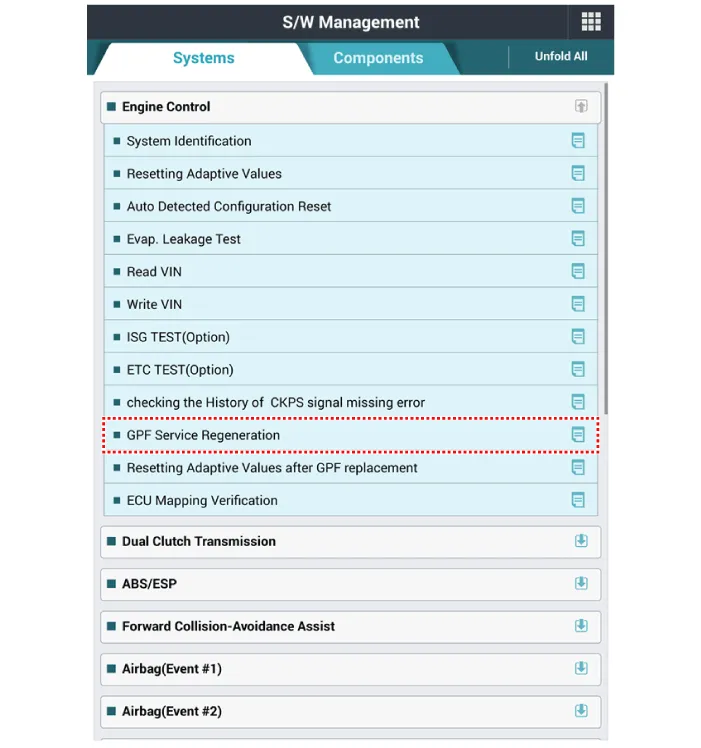
| 7. | Select "Vehicle S/W Management". |
| 8. | Select "GPF Service Regeneration".
|

| Removal |
| 1. | Turn ignition switch OFF and disconnect the battery negative (-) terminal. |
| 2. | Lift the vehicle. |
| 3. | Remove the exhaust gas temperature sensor (EGTS) #1, #2. (Refer to Engine Control / Fuel System - "Exhaust Gas Temperature Sensor (EGTS)") |
| 4. | Remove the GPF (B) after removing the installation nuts (A).
|

| Installation |
| 1. | Install in the reverse order of removal.
|

| Replacement |
|
| 1. | Turn ignition switch OFF. |
| 2. | Connect a GDS to Data Link Connector (DLC). |
| 3. | Turn ignition switch ON. |
| 4. | Select "Vehicle, Model year, Engine, System". |
| 5. | Start engine at idle and P-range (A/T) or neutral (M/T). |
| 6. | Apply electrical fully load to the vehicle (A/C ON, Blower ON with maximum speed, Head Lamp ON, Wiper ON, and Other Lamps ON, etc.). |
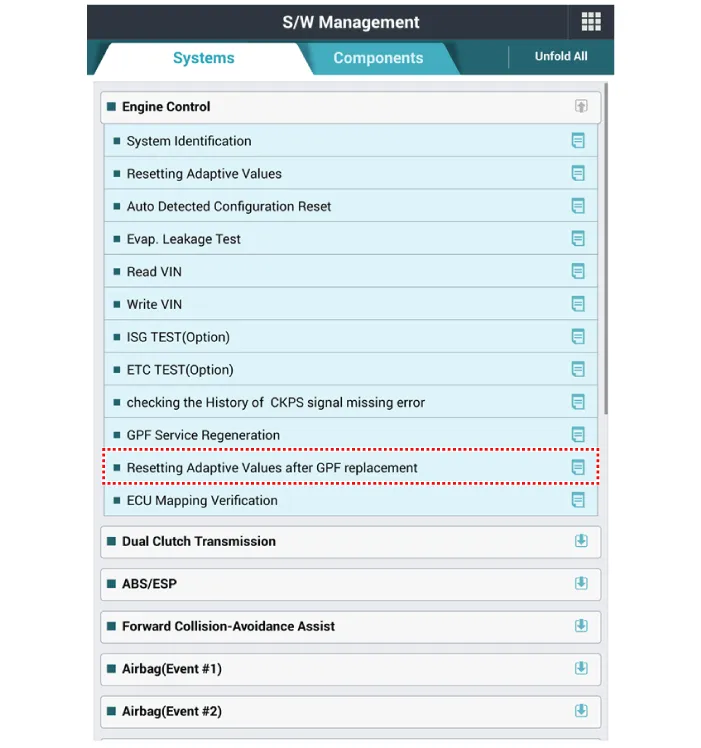
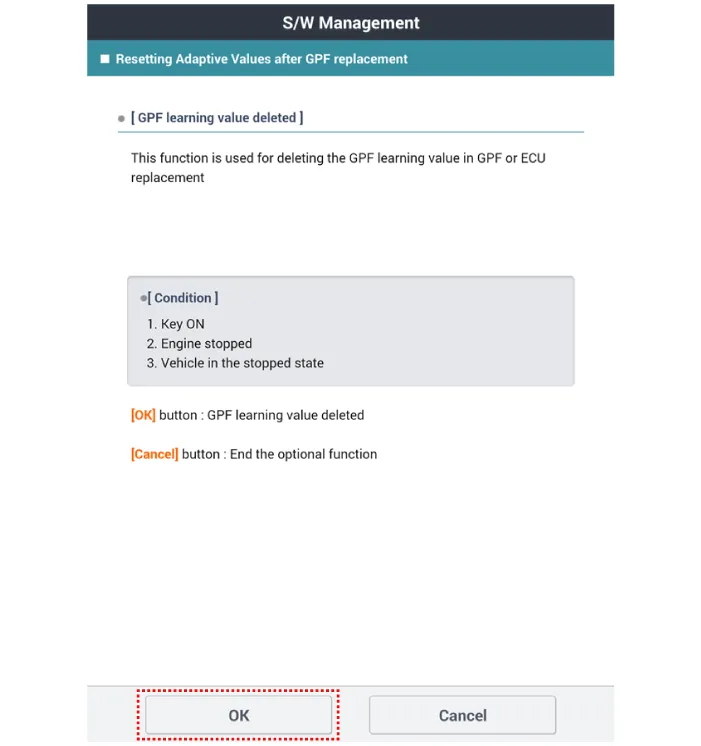
| 7. | Select "Vehicle S/W Management". |
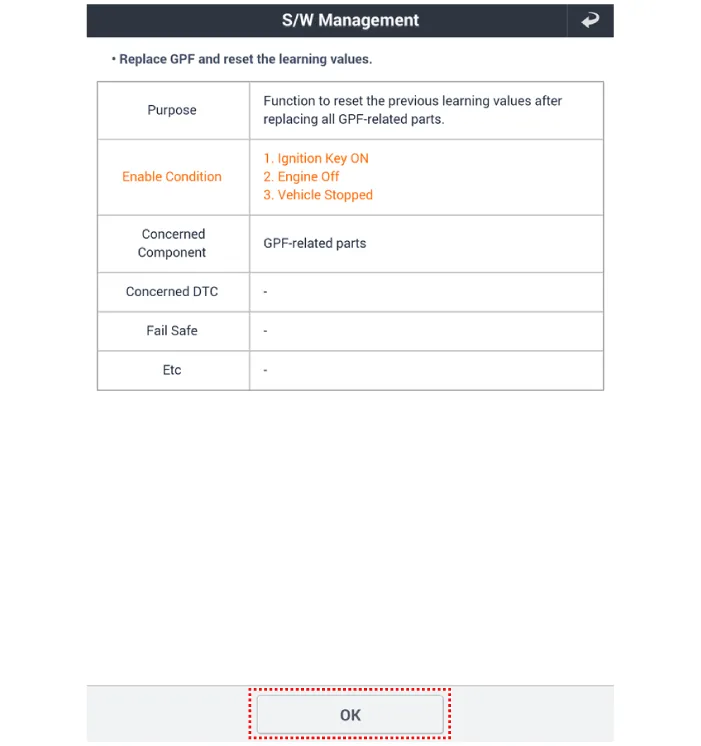
| 8. | Select "Resetting Adaptive Values after GPF replacement".
|
Schematic Diagram
Other information:
Hyundai Ioniq (AE) 2017-2022 Service & Repair Manual: Photo Sensor. Description and operation
Description The photo sensor is located at the center of the defrost nozzles.The photo sensor contains a photovoltaic (sensitive to sunlight) diode. The solar radiation received by its light receiving portion, generates an electromotive force in proportion to the amount of radiation received which is transferred to the automatic temperature control
Hyundai Ioniq (AE) 2017-2022 Service & Repair Manual: Parking Distance Warning (PDW) Sensor. Repair procedures
Removal1.Disconnect the negative (-) battery terminal.2.Remove the front / rear bumper cover.(Refer to Body - "Front Bumper Cover")(Refer to Body - "Rear Bumper Cover")3.Disconnect the connector (A) from the parking assist sensor.4.Remove the sensor (A) by pulling out both ends of the sensor holder.
Categories
- Manuals Home
- Hyundai Ioniq Owners Manual
- Hyundai Ioniq Service Manual
- Jump starting procedure
- Jump Starting
- Engine Control/Fuel System
- New on site
- Most important about car

Copyright © 2026 www.hioniqae.com - 0.0165