
Hyundai Ioniq (AE): Cooling System / Coolant. Repair procedures
Hyundai Ioniq (AE) 2017-2022 Service & Repair Manual / Engine Mechanical System / Cooling System / Coolant. Repair procedures
| Engine Coolant Refilling and Bleeding |
[Drain]
|

|

| 1. | Make sure the engine and radiator are cool to the touch. |
| 2. | Remove the reservoir tank cap (A).
|

| 3. | Remove the engine room under cover. (Refer to Engine and Transaxle Assembly - "Engine Room Under Cover") |
| 4. | Loosen the drain plug (A), and drain the coolant.
|
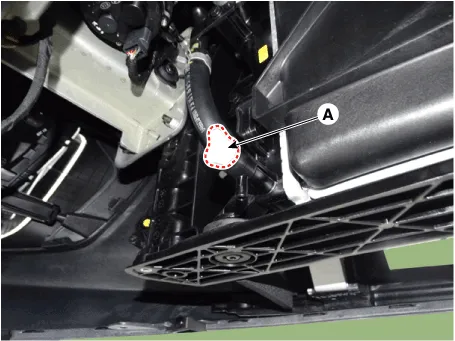
| 5. | Tighten the radiator drain plug securely. |
| 6. | After draining engine coolant in the reservoir tank, clean the tank. |
[Filling and Air Bleeding]
| 1. | Fill the radiator with water through the reservoir tank cap and tighten the cap.
|

| 2. | Start the engine and allow to come to normal operating temperature. Wait for the cooling fans to turn on several times. Accelerate the engine to aid in purging trapped air. Shut engine off. |
| 3. | Wait until the engine is cool. |
| 4. | Repeat steps 1 to 3 until the drained water runs clear. |
| 5. | Fill fluid mixture with coolant and water (55-60%) (except for North America, Europe and China : 45-50%) slowly through the reservoir tank cap. Push the upper/lower hoses of the radiator so as bleed air easily.
|
| 6. | Start the engine and run until coolant circulates.When the cooling fan operates and coolant circulates, refill coolant through the reservoir tank cap. |
| 7. | Repeat 6 until the cooling fan 3-5 times and bleed air sufficiently out of the cooling system. |
| 8. | Install the reservoir tank cap and fill the reservoir tank to the "MAX" (or "F") line with coolant. |
| 9. | Run the vehicle under idle until the cooling fan operates 2-3 times. |
| 10. | Stop the engine and wait coolant gets cool.
|
Components1. Cooling fan2. Fan motor3. Cooling fan shroud4. Cooling fan controller (PWM)5. Cooling fan upper guard
Other information:
Hyundai Ioniq (AE) 2017-2022 Service & Repair Manual: High voltage shut-off procedures
High Voltage Shut-off Procedures • Be sure to read and follow the "General Safety Information and Caution" before doing any work related with the high voltage system. Failure to follow the safety instructions may result in serious electrical injuries.
Hyundai Ioniq (AE) 2017-2022 Service & Repair Manual: Smart Cruise Control (SCC) Switch. Repair procedures
Removal1.Disconnect the negative (-) battery terminal.2.Remove the steering wheel assembly.(Refer to Steering System -"Steering Wheel")3.Remove the steering back cover (A).4.Remove the steering remote control connector (A).5.Remove the steering remote control (A), after loosening the screws.
Categories
- Manuals Home
- Hyundai Ioniq Owners Manual
- Hyundai Ioniq Service Manual
- Engine Mechanical System
- Hybrid Vehicle Engine Compartment
- General Information
- New on site
- Most important about car

Copyright © 2026 www.hioniqae.com - 0.0127