
Hyundai Ioniq (AE): Cylinder Head Assembly / CVVT & Camshaft. Repair procedures
| Removal |
|

|

|

| 1. | Shut off the High Voltage circuit. (Refer to General Information - "High Voltage Shutoff Procedure") |
| 2. | Disconnect the battery negative terminal. |
| 3. | Remove the cylinder head cover. (Refer to Cylinder Head Assembly - "Cylinder Head Cover") |
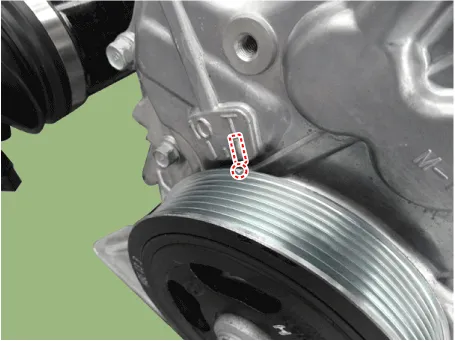
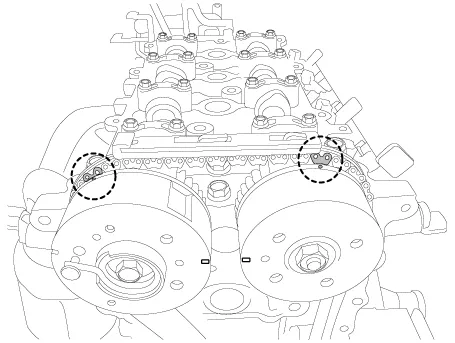
| 4. | Turn the crankshaft damper pulley and align its groove with the timing mark of the timing chain cover to set the piston of No.1 cylinder to the top dead center on compression stroke. |
| 5. | Set No.1 cylinder to TDC (Top dead center) on compression stroke.
|
| 6. | Remove the timing chain cover. (Refer to Timing System - "Timing Chain Cover") |
| 7. | Remove the timing chain. (Refer to Timing System - "Timing Chain") |
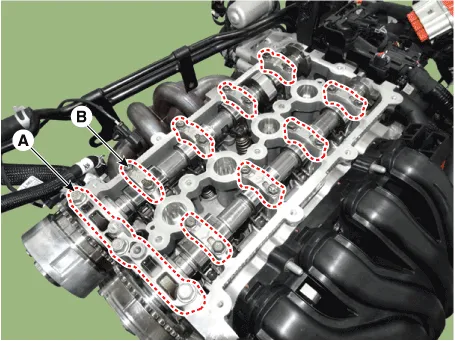
| 8. | Remove the front camshaft bearing cap (A) and the camshaft bearing caps (B).
|
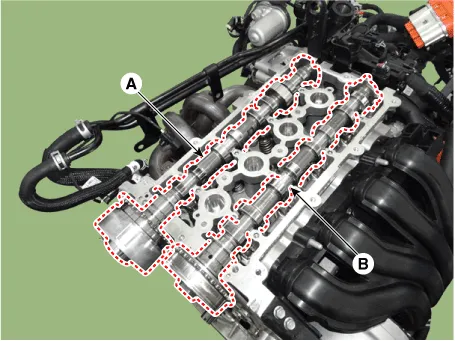
| 9. | Remove the exhaust camshaft (A) first, then intake camshaft (B).
|
| Inspection |
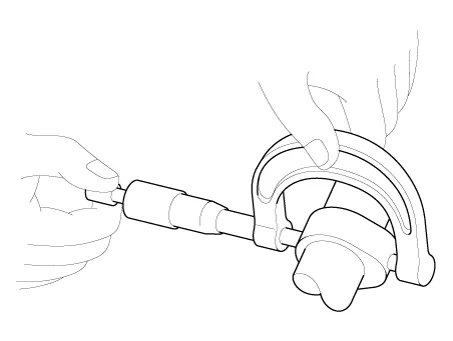
| 1. | Inspect cam lobes. Using a micrometer, measure the cam lobe height.
If the cam lobe height is less than standard, replace the camshaft. |
| 2. | Check the surface of the camshaft journal for wear. If the journal is worn excessively, replace the camshaft. |
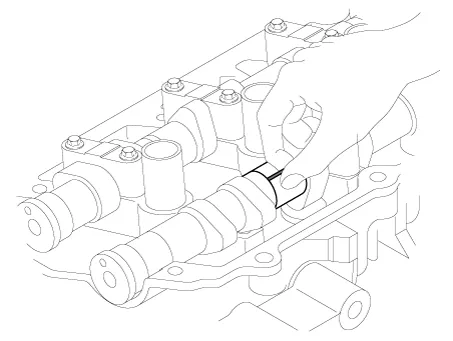
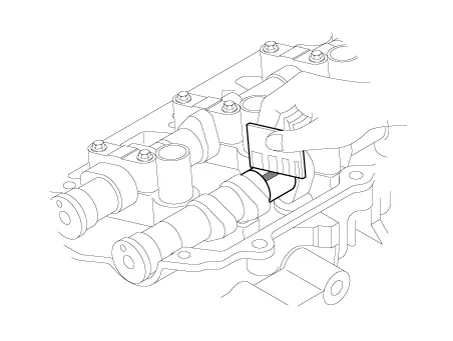
| 3. | Inspect the camshaft journal clearance.
|

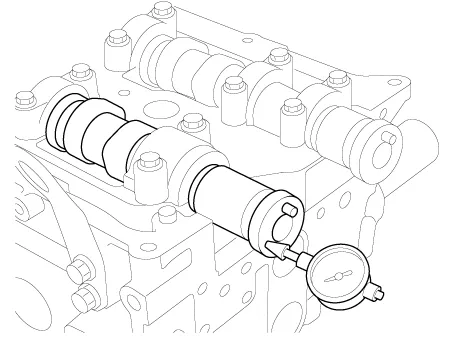
| 4. | Inspect the camshaft end play.
|
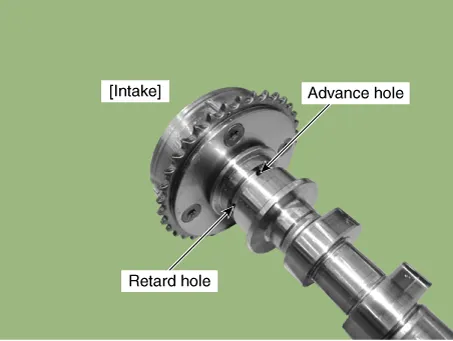
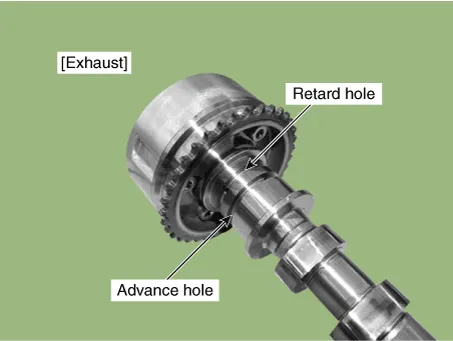
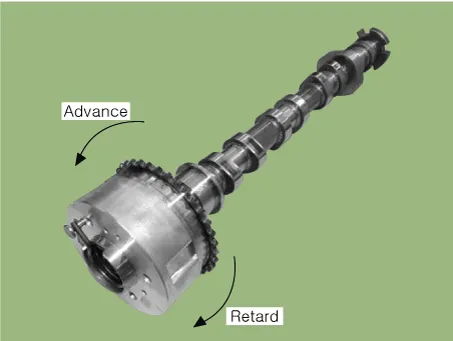
| 1. | Inspect CVVT for smooth rotation.
|

| Installation |
| 1. | Install the exhaust camshaft (A) first, then intake camshaft (B).
|
| 2. | Install the front camshaft bearing cap (A) and the camshaft bearing caps (B) as following method with specified torque.
|
| 3. | Install the timing chain. (Refer to Timing System - "Timing Chain") |
| 4. | Install the timing chain cover. (Refer to Timing System - "Timing Chain Cover") |
| 5. | Install the cylinder head cover. (Refer to Cylinder Head Assembly - "Cylinder Head Cover") |
| 6. | Connect the High Voltage circuit. (Refer to General Information - "High Voltage Shutoff Procedure") |
DescriptionThe continuous variable valve timing (CVVT) system advances or retards the opening of an intake or exhaust valve according to the ECM signals that are determined based on engine RPM and load.
Components1. Cylinder head assembly2. Cylinder head gasket3. Retainer lock4. Retainer5. Valve spring6. Valve stem seal7. Valve8. Swing arm9. Hydraulic lash adjuster (HLA)
Other information:
Hyundai Ioniq (AE) 2017-2022 Service & Repair Manual: In-car Sensor. Repair procedures
Diagnosis With GDS1.The heating, ventilation and air conditioning can be quickly diagnosed failed parts with vehicle diagnostic system (GDS).※ The diagnostic system (GDS) provides the following information.(1) Self diagnosis : Checking the failure code (DTC) and display.
Hyundai Ioniq (AE) 2017-2022 Service & Repair Manual: Auto Defogging Sensor. Description and operation
DescriptionThe auto defogging sensor is installed on the front window glass. The sensor judges and sends signal if moisture occurs to blow out wind for defogging. The air conditioner control module receives signal from the sensor and restrains moisture and eliminate defog by controlling the intake actuator, A/C, auto defogging actuator, blower moto
Categories
- Manuals Home
- Hyundai Ioniq Owners Manual
- Hyundai Ioniq Service Manual
- Hybrid Control System
- Jump Starting
- Front Disc Brake. Repair procedures
- New on site
- Most important about car
