
Hyundai Ioniq (AE): Evaporative Emission Control System / Canister. Repair procedures
| Removal |
| 1. | Turn ignition switch OFF and disconnect the negative (-) battery cable. |
| 2. | Remove the fuel tank. (Refer to Engine Control/Fuel System - "Fuel Tank") |
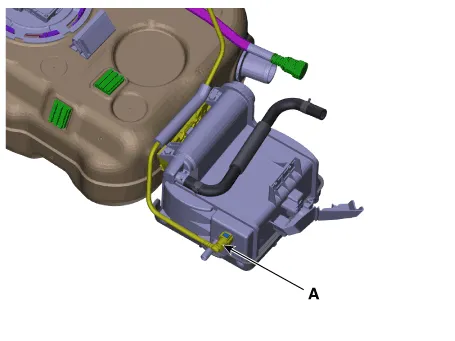
| 3. | Disconnect the vapor tube quick-connector (A).
|
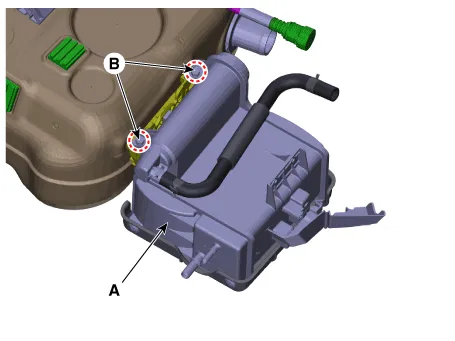
| 4. | Remove the canister (A) from the fuel tank after loosening the bolts (B).
|
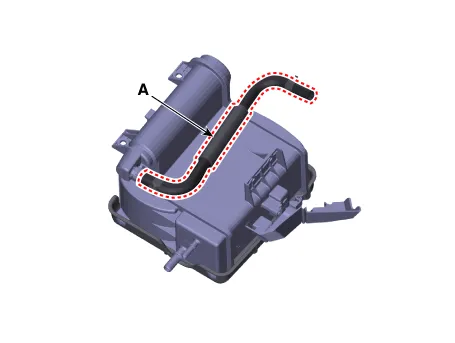
| 5. | Disconnect the vapor hose (A).
|
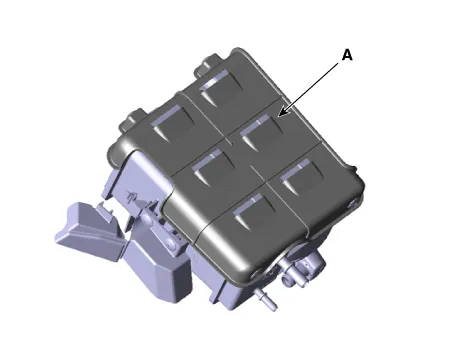
| 6. | Remove the canister protectors (A).
|
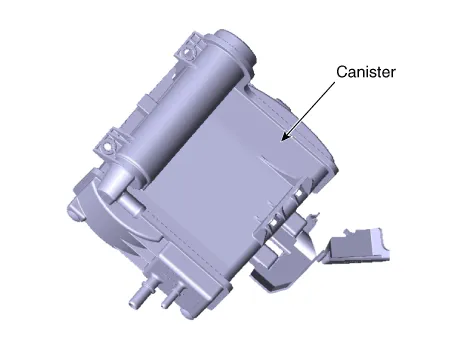
| Inspection |
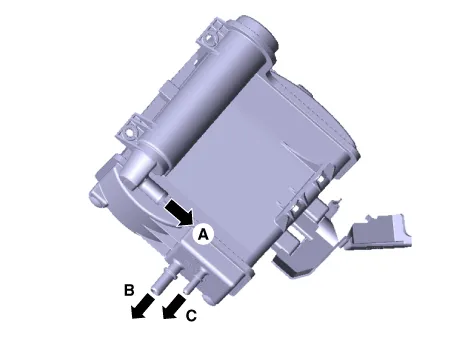
| 1. | Check for the following items visually.
A : Canister ↔ Atmosphere B : Canister ↔ Intake Manifold C : Canister ↔ Fuel Tank |
| Installation |
| 1. | Install in the reverse order of removal. |
Schematic DiagramCanisterCanister is filled with charcoal and absorbs evaporated vapor in fuel tank. The gathered fuel vapor in canister is drawn into the intake manifold by the ECM/PCM when appropriate conditions are set.
Replacement1.Turn ignition switch OFF and disconnect the negative (-) battery cable.2.Remove the filler-neck assembly(Refer to Engine Control/Fuel System - "Filler-Neck Assembly")3.
Other information:
Hyundai Ioniq (AE) 2017-2022 Service & Repair Manual: Heater Unit. Repair procedures
Replacement When prying with a flat-tip screwdriver or use a prying trim tool, wrap it with protective tape, and apply protective tape around the related parts, to prevent damage.1.Disconnect the negative (-) battery terminal.2.Recover the refrigerant with a recovery / recycling / charging station.
Hyundai Ioniq (AE) 2017-2022 Service & Repair Manual: Evaporator Core. Repair procedures
Replacement1.Disconnect the negative (-) battery terminal. 2.Remove the heater and blower assembly.(Refer to Heater - "Heater Unit") 3.Remove the evaporator core cover (A) after loosening the mounting screws.4.Pull out the evaporator temperature sensor (A) from the evaporator core.
Categories
- Manuals Home
- Hyundai Ioniq Owners Manual
- Hyundai Ioniq Service Manual
- Body (Interior and Exterior)
- Transmission Gear Oil. Repair procedures
- Engine Mechanical System
- New on site
- Most important about car
